Article
How to Convince Your Principal That Your Whole School Needs Common Planner
Discover the benefits of a school-wide subscription and get a ready-to-send email to help you make the case.
June 16, 2016

June 16, 2016
While researching this topic, I realized that there are major but distinct problems with how most schools and districts complete the curriculum mapping process. This piece will focus on the history of curriculum mapping as it relates to schools and how the current reality of curriculum mapping has become separated from the original intent of school-wide curriculum mapping.
Everyone who works at Cc is opinionated. And our different experiences and perspectives on education mean we rarely completely agree. So it was very weird when we all had the same thoughts and experiences with curriculum maps — that, in their current form, they have almost no value for teachers.
“Why do curriculum writers even create curriculum maps!?” -Robbie, one of the co-founders of Cc
Well, I took a deep dive into that question and have a new-found respect for how the curriculum mapping process should work while I am also disappointed that few schools are actually following this process. Curriculum mapping should be an individualized, school-based process that increases vertical and horizontal collaboration, not a useless document that is handed to teachers by district curriculum writers. Every teacher and school can benefit from thinking through why they teach what the teach and why they have delivered instruction in the order that they have. The collaboration that takes place during the curriculum mapping process leads to a well-thought-out, school-wide curriculum.
A week before school started in my first year of teaching, I was handed a document that my administration called a curriculum map. It looked something like this:
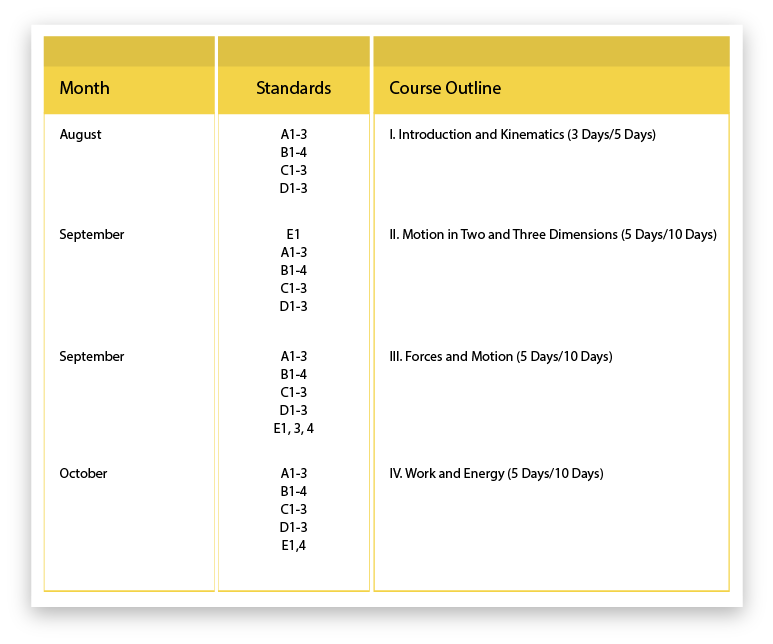
I was given no training or additional information. Just this map. I looked at this document and thought, “What does standard A1–3 even include and why am I spending three weeks on it?” Not to mention, “I can’t start teaching physics equations on day one, shouldn’t I need to check my students’ math abilities first?!” A million other questions came to mind, but no answers. This list of standards on a page gave me almost zero support; it came off as arbitrary numbers and timelines. It was obvious that this map was un-rooted in the reality of my classroom, even to a new teacher like me.
I was overwhelmed with the million other things I had to do, so I quickly put this curriculum map in the bottom drawer of my filing cabinet and didn’t take it out again until the last week of school when I was cleaning out my classroom. Each year after this, I repeated the same meaningless ritual. I was handed a curriculum map. I put it in the drawer. Curriculum map. Drawer. Year after year.
In my teaching experience, not only did these sorts of curriculum maps not help me, but they hurt me; they made me complacent. I thought curriculum mapping was checked off my list because I had that curriculum map sitting in a drawer. I never once started a discussion about curriculum mapping at my school and this definitely wasn’t what was intended by the people who created curriculum mapping.
Curriculum maps are meant to predict and then record the actual day-to-day instruction that goes on at a school. Most importantly, they are meant to be realistic predictions and actual records of what instruction took place. Curriculum maps are customizable and, like lesson plans, can have many different templates. They ideally include standards, essential questions, content, skills, and assessments.
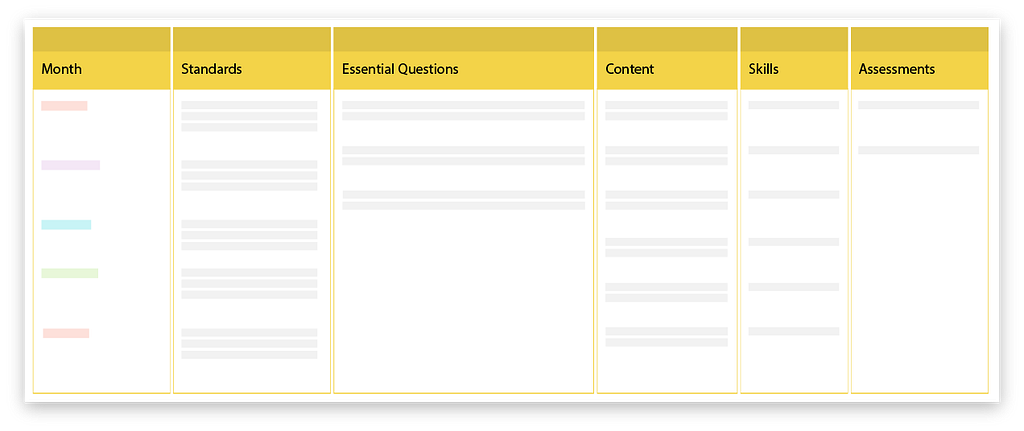
Fenwick English (opens in a new tab) first introduced the idea of curriculum maps in 1980. He was a proponent of teachers recording what they were actually teaching, instead of assuming teachers were going to follow district curriculum to the letter. But the curriculum mapping process was not fully fleshed out until Dr. Heidi Hayes Jacobs (opens in a new tab) published her work in the late 1990’s and early 2000’s.
In her book, Mapping the Big Picture (opens in a new tab), Jacobs outlines a seven-step process for schools which creates constant reflection and revision of both individual teacher and school-wide curriculum maps. To summarize this process:
To summarize, according to Dr. Susan Udelhofen (opens in a new tab), author of Keys to Curriculum Mapping: Strategies and Tools to Make it Work (opens in a new tab), curriculum mapping is a “process-oriented model that is respectful of the knowledge of every teacher, encourages collaboration and reflection, and is sensitive to the complexities of student learning and the teacher profession.” I know that sounds unnecessarily technical, but the idea of a curriculum mapping as a process to keep teachers constantly collaborating and reflecting on what they are actually teaching is really freaking cool and totally not what I got when I was a teacher.
Jacobs’ main idea is that curriculum mapping should not be a spectator sport, instead, it demands teachers’ ongoing preparation and active participation. Her point was never to have curriculum writers build a map once and hand it off to teachers, instead curriculum mapping is meant to be a process that makes a school more collaborative and reflective.

”Curriculum mapping should not be a spectator sport, instead, it demands teachers ongoing preparation and active participation”
I have talked to many teachers about curriculum maps in preparation for this post and none of them had followed this process outlined by Jacobs. All the teachers were handed curriculum maps from their district. Some of those maps were more detailed and useful than others. So some teachers used the maps more often than others, but still, no one was following Jacobs’ process.
At Common Curriculum, we hypothesize that somewhere along the line, since teachers were handed curriculum maps from higher ups, teachers stopped thinking they needed to complete the curriculum mapping process. Online I found many records of teachers saying things like, “Why reinvent the wheel?” (opens in a new tab); “I say just get the CMap done so your admin is happy.” (opens in a new tab); and “We already have a scope and sequence. (opens in a new tab)” These are the words of teachers who think the map they were given replaces the need to complete the curriculum mapping process; teachers didn’t see the need. These are all thoughts I’ve had before, and so I completely understand why teachers do not jump at the idea of taking the extra time to turn in curriculum maps. It just seems, through no ones fault in particular, the curriculum mapping process stopped being about the improvement of instruction and started being about compliance.
The curriculum mapping process that Jacobs’ outlined helps schools ensure that:
Instead of looking at my map of standards on a page, I could have used them as a starting point to outline what I wanted to do in my classroom. Instead of filing the curriculum map in a drawer, I could have discussed with other teachers who taught in my grade level to identify ways we could collaborate on different groups of standards. And I definitely could have used this constant reflection to create a constantly improving document that would have improved my practices from year to year.
Many schools are already implementing strategies that allow teachers to collaborate and constantly re-iterate their long-term plans. Those schools may not need to complete the curriculum mapping process (curriculum mapping is just one strategy to meet the goal of increased collaboration) but my school definitely needed work in all of the areas listed above.

We hope that an increased understanding of the role that curriculum mapping was meant to play in schools will give you the information you need to advocate for a better curriculum mapping process at your school. Teachers, if you were anything like me and were handed a pointless curriculum map, don’t just file it away. Ask that your school uses the strategies from Jacobs’ process to increase the collaboration around long-term planning at your school. Even if your school is focused on other school-wide improvements, ask that your district curriculum writers provide more detailed scope and sequences that support a robust classroom curriculum. Do it! Do it now!
If your school is implementing the curriculum mapping process with success, please reach out! If you are frustrated with the way most districts do it like we are, please reach out! If you have mixed feelings, please reach out! We just might write a follow-up post about your story.
You can reach us via email, Facebook (opens in a new tab), or on Twitter (opens in a new tab).
Originally published at blog.commoncurriculum.com on June 16, 2016.
Keep reading
Discover the benefits of a school-wide subscription and get a ready-to-send email to help you make the case.
A shared planbook helps co-teachers stay aligned, add student supports, and plan together even when they can't meet.
Make substitute teacher plans easier with Common Planner. Keep lessons, materials, and directions together, then share exactly what your sub needs.